Why Use AI for Translation in Today’s Global Communication?
In today's interconnected world, effective communication is essential. Businesses expand across borders. Individuals connect regardless of language barriers. Here, AI for translation plays a crucial role. It enhances understanding among diverse cultures and languages.
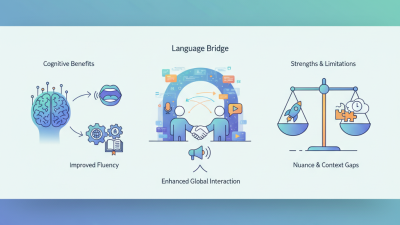
AI for translation offers speed and efficiency. Traditional methods often struggle to keep pace. With AI, translations are faster and accessible. Yet, there are concerns. Machine translations can lack nuance and context. Idiomatic expressions may not always translate well. This raises questions about reliability and quality.
To address these challenges, it’s vital to combine AI with human expertise. Collaboration can improve accuracy. While AI aids in overcoming barriers, it is not infallible. Human oversight is necessary for nuance. As we embrace AI for translation, we must remain critical of its limitations. A balanced approach ensures effective communication in our globalized society.
Benefits of AI Translation in Enhancing Communication Efficiency
In today's interconnected world, AI translation plays a vital role in enhancing communication efficiency. Businesses now operate across borders. Miscommunication can lead to significant losses. AI translation tools reduce language barriers swiftly. They provide instant translations, making it easier for teams to collaborate internationally. This saves time and resources, crucial for timely project completion.
Additionally, AI translation offers consistency in messaging. Automated tools apply the same style and terminology throughout various documents. This leads to a clearer understanding of objectives among partners. However, reliance on AI may overlook nuances. Human translators can capture cultural context and emotion better. There is a fine balance between automation and human touch.
Despite its advantages, AI translation is not without flaws. Errors can occur due to idiomatic expressions or regional dialects. Users might misinterpret automated translations. Businesses should remain aware of these limitations. Combining AI with human review could enhance accuracy. The effectiveness of communication relies on both technology and human insight.
The Role of AI in Breaking Language Barriers Globally
In today's interconnected world, language barriers can hinder communication across cultures. AI plays a pivotal role in breaking these barriers. Powerful translation tools now enable instant comprehension of diverse languages. These technologies allow people to engage in meaningful conversations regardless of their native tongue.
Through machine learning, AI systems analyze vast amounts of text. They learn the nuances of various languages quickly. Yet, this rapid advancement raises questions about accuracy. Automated translations can sometimes misinterpret idioms or cultural references. For instance, phrases that have deep cultural significance may lose their meaning in translation. The reliance on AI must be balanced with human skills to ensure clarity and context.
As we embrace AI in translation, challenges remain. Not all languages are equally represented in AI training data. Smaller languages might face a lack of resource investment. This creates a risk of marginalizing certain cultures. Continuous improvement is necessary. It’s essential to monitor AI translations closely. By understanding its limitations, we can enhance global communication while respecting linguistic diversity.
AI Translation Technologies: How They Work and Their Accuracy
AI translation technologies have transformed global communication. These tools leverage advanced algorithms to analyze language patterns. By using vast datasets, they learn the nuances of different languages. This learning process helps improve translation accuracy over time. Despite their advancements, the technology is not flawless. Contextual meanings can still be misunderstood, leading to translation errors.
Machine learning models play a crucial role in translation. They utilize neural networks, which mimic human brain functions. These networks process language in a way that considers both grammar and meaning. However, cultural references may be overlooked. This can result in awkward translations that don't resonate with native speakers. Continuous training and refinement are necessary to address these challenges.
User feedback is vital for improving translation accuracy. When users report errors, it helps finely tune the algorithms. AI tools rely on human insights to evolve. Still, there are limitations to consider. Some idiomatic expressions may not translate well, causing confusion. Ongoing development in this field aims to bridge these gaps and enhance communication.
Case Studies of Successful AI Translation Applications in Business
In today's global economy, AI translation plays a vital role. Businesses across various sectors have successfully integrated AI tools to enhance communication. For instance, a multinational company utilized AI-driven translation software to streamline its customer support. By providing real-time assistance in multiple languages, they increased customer satisfaction. This decision also reduced response times significantly, showcasing the efficiency AI brings.
Another example comes from the e-commerce sector. A platform used AI translation to adapt product descriptions for different markets. They faced challenges initially, such as inaccurate translations. However, by using machine learning algorithms, the system improved over time, leading to higher sales and better customer engagement. This highlights the ongoing need for refinement in AI solutions.
Companies must remain aware of potential pitfalls. Accuracy is key, but contexts can be lost in translation. AI translation should complement human expertise, not replace it entirely. Real-world applications show that while AI is powerful, it requires oversight to ensure reliability and nuance in communication.
AI Translation Effectiveness in Business Communication
Future Trends in AI Translation and Global Communication Strategies
The landscape of global communication is rapidly evolving. AI translation tools are becoming fundamental to this change. As businesses expand globally, the demand for quick and accurate translations grows. Companies must adapt to new markets. This adaptation often requires a blend of automated solutions and human insights.
In the near future, AI translation will focus on context and culture. Current models translate words but sometimes miss nuances. Language is complex, and meaning can vary. There's a need for systems that understand social and cultural subtleties. This evolution will lead to more natural communication. AI must enhance, not replace, human involvement. Effective strategies will rely on collaboration between tools and skilled translators.
Moreover, ethical considerations will play a critical role. Companies must ensure that AI tools are fair and unbiased. Reliance on technology raises questions about accuracy and representation. Continuous feedback loops will be vital for improvement. Integration of feedback must be systematized. This approach avoids stagnation and promotes growth in translation quality. Future global communication hinges on these developments.
Why Use AI for Translation in Today’s Global Communication? - Future Trends in AI Translation and Global Communication Strategies
| Dimension |
Description |
Impact |
| Accuracy |
Improvement in translation accuracy through AI algorithms. |
Enhances understanding between cultures. |
| Speed |
Real-time translation capabilities. |
Facilitates faster communication across borders. |
| Cost-Effectiveness |
Reduction in translation service costs. |
Enables businesses to allocate resources better. |
| Language Accessibility |
Supports a wider range of languages and dialects. |
Increases inclusivity in global communication. |
| Cultural Context |
Incorporates cultural nuances in translations. |
Improves relatability of content to local audiences. |
.svg)


.svg)

.svg)


 052925 - AI Translation 101 (1).png)


.svg)

.svg)


.jpg)