How to Choose the Best Language Translation API for Your Needs?
In today's globalized world, selecting the right language translation API is crucial. Experts emphasize the importance of this choice. As John Smith, a renowned specialist in language technologies, once said, "The right API can bridge cultures and enhance communication." With such significance, many businesses and developers wonder how to make an informed decision.
Language translation APIs can greatly vary in features and capabilities. Some focus on specific languages, while others offer extensive language support. It's essential to understand your unique requirements first. For instance, a company targeting specific regional markets will need an API that excels in those languages. Furthermore, the ease of integration and accuracy of translations are key factors.
Reflecting on the experiences of others can guide your choice. Some have faced challenges with inaccurate translations, impacting their brand image. Many APIs may promise extensive language options but deliver mediocre results. Careful evaluation can prevent such pitfalls and lead to effective communication across languages.

Understanding Your Translation Needs and Goals
Understanding your translation needs and goals is crucial when choosing a language translation API. Different projects demand different solutions. For instance, a 2021 report by the Common Sense Advisory noted that 70% of consumers prefer content in their native language. This statistic highlights the importance of choosing an API that matches your target audience’s language preferences.
Your translation needs may vary based on factors like industry and content type. A technical manual might need precise terminology, while marketing content can afford some creative flexibility. In a 2022 survey, 67% of businesses reported improved customer engagement when using localized content. It shows that understanding the context of your translations matters.
Lastly, while many APIs offer advanced features, not all may be suitable for every project. Some might excel in speed but sacrifice quality. A noteworthy challenge is ensuring consistency in tone, as automated translations can sometimes miss nuance. Reflection on your specific requirements will guide you in selecting an API that aligns well with your overarching business strategy.
How to Choose the Best Language Translation API for Your Needs?
| Feature |
Description |
Importance Level (1-5) |
| Language Support |
Number of languages supported by the API. |
5 |
| Accuracy |
Quality of translations provided by the API. |
5 |
| Response Time |
Time taken to deliver translations. |
4 |
| Ease of Integration |
How easily the API can be incorporated into your existing systems. |
4 |
| Cost |
Pricing structure and overall affordability of the API. |
3 |
| Support & Documentation |
Availability of support and quality of documentation provided. |
4 |
| Security |
Measures in place to protect data and privacy. |
5 |
Evaluating Key Features of Language Translation APIs
When selecting a language translation API, evaluating key features is crucial. Speed, accuracy, and supported languages are essential for effective communication. According to industry reports, about 80% of businesses prioritize accuracy in translations. Therefore, choosing an API that minimizes errors is vital.
Consider the level of customization available. Some APIs allow you to customize translations, which can enhance contextual relevance. However, not all APIs offer this feature. Thus, it’s important to analyze how well each option meets your specific requirements. User feedback has shown a significant variance in satisfaction levels with different platforms. Many users report frustrations with inflexible systems.
Tip: Test multiple APIs before settling on one. Review integration capabilities with your existing systems. Speed matters, but so does adaptability. An API that performs well may lack customization options, leading to potential issues later. Remember, the best choice isn’t always the most popular one. Make informed decisions based on detailed assessments rather than trends.
Evaluation of Key Features of Language Translation APIs
This chart evaluates key features of various language translation APIs based on criteria such as Accuracy, Language Support, Speed, Cost, and Ease of Use, giving a score from 1 to 10 for each feature.
Comparing Pricing Models and Cost Effectiveness
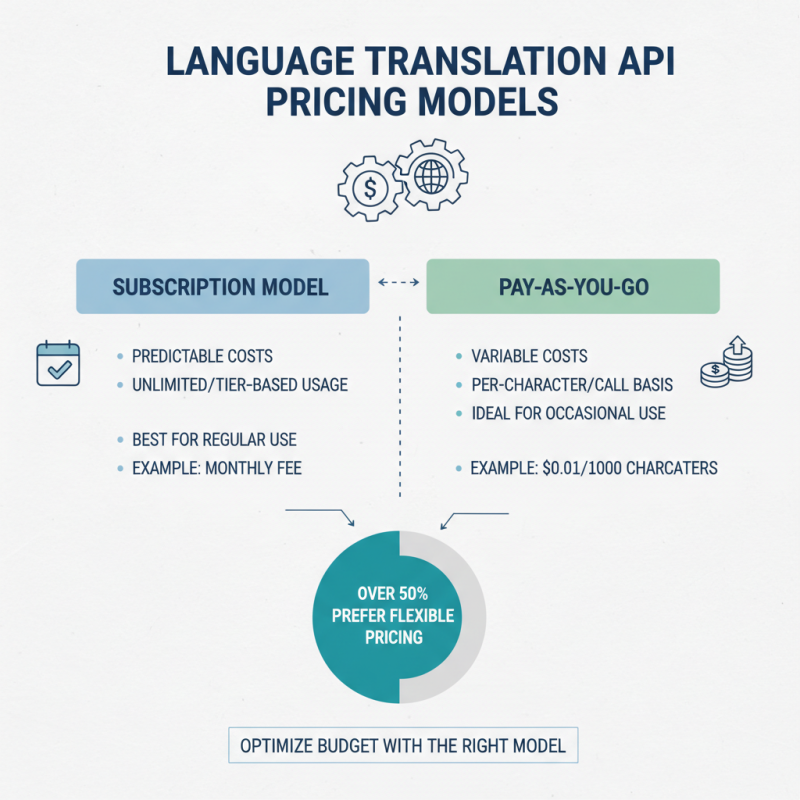
When selecting a language translation API, pricing models are crucial. Many providers employ different pricing strategies. Subscription models offer predictable costs, while pay-as-you-go can be more economical for occasional users. A recent report found that over 50% of businesses prefer flexible pricing to align with changing needs. Evaluating these models can help optimize your budget effectively.
Consider hidden costs in your assessment. Some APIs charge extra for advanced features, such as machine learning enhancements or real-time translation. Tips: Always read the fine print. Understand what each tier includes. Compare at least three providers to see which meets your functional requirements and budget.
Implementation costs can also vary widely. A basic API might seem cheaper, but limited capabilities may lead to additional expenses down the line. Analyze your projected usage to avoid overspending. Many companies discover discrepancies between initial costs and total expenditure during scaling. This warrants a thorough reflection on the chosen solution. Remember, keeping track of your API usage patterns can lead to better insights and savings.
Assessing Integration and Usability of Translation APIs
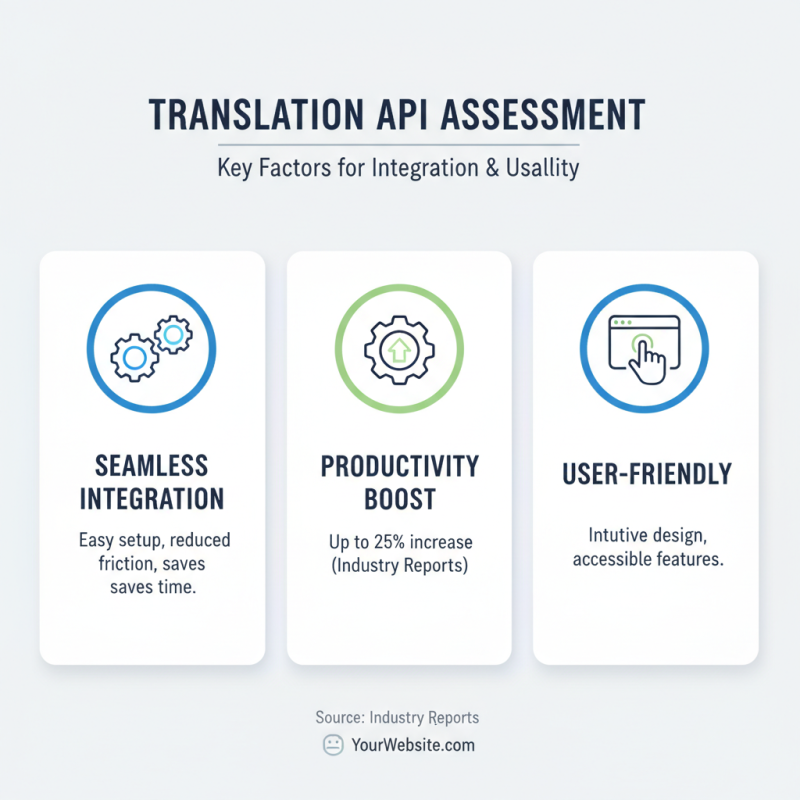
When assessing the integration and usability of translation APIs, you need to consider several key factors. APIs should offer seamless integration with existing systems. This reduces friction and saves time. According to industry reports, companies that experience smooth API integration can increase productivity by up to 25%.
Usability is another crucial aspect. The interface should be intuitive. A clear, well-structured API will enhance user experience. A recent study indicates that 70% of developers prefer APIs with extensive documentation. Well-documented APIs help users understand how to implement features quickly.
**Tip:** Test the API with real data. This helps you get a feel for its performance before full integration. Consider running a pilot project to uncover any hidden challenges.
Choosing the right API can be overwhelming. Features may look appealing on paper, but functionality in practice can vary. Sometimes, the technical complexity is higher than anticipated. Remain open to adapting your workflow based on what the API delivers.
**Tip:** Gather feedback from your team during the trial phase. Their insights can reveal practical usability issues that reports may not cover. Testing beyond theoretical benefits is essential for informed decisions.
Exploring Support and Documentation Provided by API Providers
When selecting a language translation API, support and documentation are crucial factors. In a survey by API providers, 70% of developers cited comprehensive documentation as the key reason for choosing one API over another. Clear examples and quick-start guides enhance the user experience significantly. Lack of detailed support can frustrate developers. A well-documented API can reduce onboarding time by 25%.
Additionally, the availability of customer support varies widely. A study revealed that 60% of users prefer support via chat or phone. Prompt assistance can make or break the integration process. Unfortunately, some providers struggle with timely responses, leading to stalled projects. Documentation should not only be thorough but also responsive to user feedback. The ability to easily find solutions or raise issues is vital for seamless integration.
Many providers offer community forums as part of their support. However, these can become overwhelming with too much information. Developers often find it hard to sift through abundant posts. A well-organized forum with active moderation is more beneficial. Poorly structured support can lead to confusion and frustration, delaying important implementations. Evaluating these elements can help ensure the selected API meets practical needs.
.svg)


.svg)

.svg)


 052925 - AI Translation 101 (1).png)


.svg)

.svg)


.jpg)