Top 10 Aluminum Extrusion Die Manufacturers Worldwide
Aluminum Extrusion Die manufacturers work where metallurgy meets precision engineering. Their dies shape hot billets into window frames, heat sinks, rail components, and complex industrial profiles. A small error in bearing length or metal flow can leave a visible twist along a long extrusion. The stakes are practical.
Demand adds pressure. The International Aluminium Institute has projected that global aluminium demand could rise by nearly 40% by 2030, compared with 2020 levels. That projection is not a guarantee, but it signals why buyers scrutinize tooling capacity, design support, and repeatability. The Aluminum Extruders Council’s technical resources also underline how die design and process control affect profile quality. Reports describe broad trends; they do not rank individual suppliers.
A useful expert lens comes from Dr. Don McCauley, an aluminum-extrusion researcher and author of The Aluminum Extrusion Manual. His work emphasizes the close relationship between tooling design and extrusion performance. In paraphrase: balanced metal flow matters as much as accurate machining. That is a practical reminder, not a universal formula. Alloy, press size, profile geometry, and production volume can change what “best” means.
This guide compares ten manufacturers worldwide. It considers engineering capability, manufacturing range, technical support, and suitability for different applications. Buyers should verify current facilities, certifications, and references directly; company capabilities can change. A polished catalogue is not proof of consistent performance. The right die partner is the one that can explain its choices, troubleshoot real production issues, and deliver repeatable profiles.
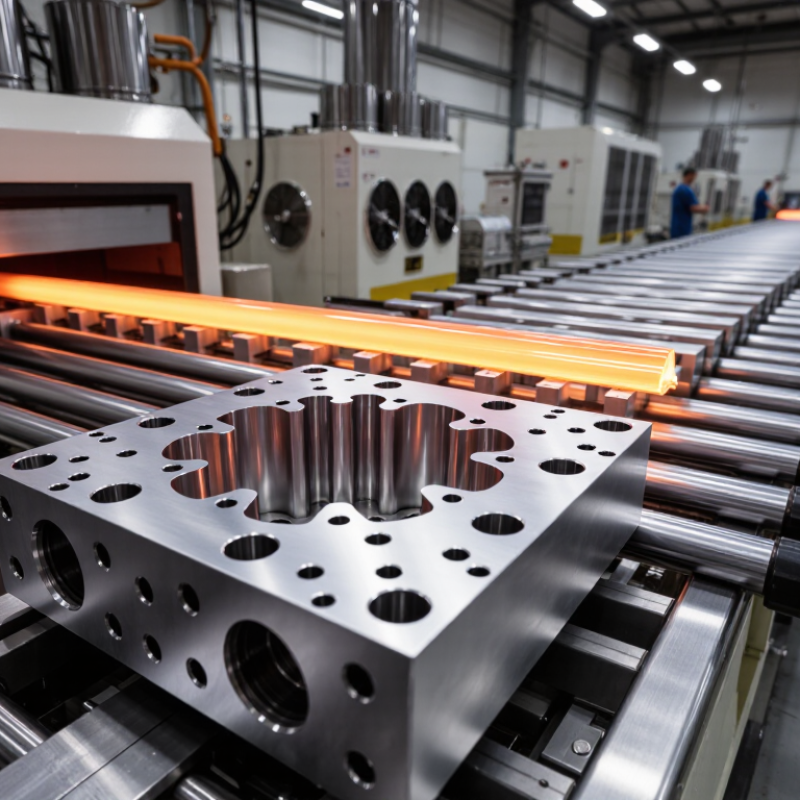
What Aluminum Extrusion Dies Do in the 450–500°C Forming Process
At 450–500°C, an aluminum billet is hot enough to flow through a die, but it is not molten. The Aluminum Extruders Council’s Aluminum Extrusion Manual describes billet temperatures in this working range; die preheating is also essential to limit thermal shock. Small changes matter. A cold die can chill the metal at the opening, while a hot spot can accelerate local flow and distort a thin wall. The die’s bearing lands—the narrow surfaces that guide the emerging profile—help balance metal speed across complex shapes.
ASM Handbook, Volume 14A, treats extrusion temperature, pressure, and material flow as linked process variables, not separate settings. In practice, operators watch billet temperature, press speed, and the profile as it exits: a long, bright strand may still twist or vary in thickness as temperatures shift. Die design helps manage that flow, but it cannot erase every process fluctuation. That simple picture is incomplete. The stated temperature ranges are operating guides, not universal prescriptions; alloy, section thickness, and press conditions change the right settings. Even a carefully prepared die may need adjustment after the first trial run.
Die Types, 10:1–100:1 Extrusion Ratios, and Common Applications
An extrusion ratio compares a billet’s starting cross-sectional area with the profile’s final area. At 10:1, metal flow is relatively gentle; near 100:1, deformation and press load can rise sharply. These figures are useful guides, not universal limits. Alloy, billet temperature, bearing length, and press capacity all affect the result. The ratio alone can mislead.
Solid dies form open shapes such as flat bars, angles, and heat-sink fins. Hollow dies use portholes and a welding chamber to join metal streams around a mandrel, creating tubes or multi-channel sections. Semi-hollow dies produce partly enclosed shapes, often with narrow openings. Flow balancing matters. Tiny differences count.
Designers may choose lower ratios for thick structural sections and higher ratios for thin-walled, detailed profiles, when the alloy and press allow. Window frames, vehicle rails, and cooling components each have distinct demands. A sharp corner may slow flow; a thin rib may run hot or distort. Die trials expose these issues, though the first adjustment is not always the right one. Track exit temperature, surface lines, and dimensional drift before revising the die.
How to Assess Die Makers by Precision, Tool Life, and Production Capacity
Top 10 Aluminum Extrusion Die Manufacturers Worldwide: Assessing Precision, Tool Life, and Capacity
A capable die maker proves precision with repeatable measurements, not a polished sample alone. Ask for first-article inspection results and process-control records across multiple production runs. Check critical dimensions, straightness, surface finish, and consistency after temperature changes. Tolerances depend on profile geometry and the agreed specification, so define acceptance limits before ordering. The International Aluminium Institute reported about 70.6 million tonnes of primary aluminium production in 2023. That scale makes reliable tooling and predictable output commercially important, but it does not guarantee any supplier’s performance.
For tool life, request maintenance logs showing tonnes produced or cycles completed before correction, separated by alloy and profile type. Compare like with like: a simple solid profile is not a fair benchmark for a thin-walled, complex shape. Ask what causes early wear and how repairs affect dimensions. Capacity also needs evidence. Review press compatibility, shifts, current workload, backup tooling, and typical lead times. A large stated capacity can hide a bottleneck in machining or die correction. One uncomfortable point: supplier records may not reflect your own alloy, press, or operating conditions.
Tips: Share a representative drawing and operating requirements. Request a trial run, measured parts, and a written definition of tool-life expectations. Agree on reporting intervals before production begins.
Top 10 Aluminum Extrusion Die Manufacturers Worldwide and Their Specialties
Worldwide, the strongest extrusion-die manufacturers usually specialize rather than cover every application equally. Some excel at solid and hollow dies for architectural profiles; others focus on thin-wall sections, large industrial shapes, or precision automotive components. Grand View Research valued the global aluminum extrusion market at USD 87.4 billion in 2022 and projected 7.7% annual growth through 2030. That demand puts pressure on die makers to balance output, surface finish, and dimensional accuracy. A polished catalogue cannot show how a die behaves after repeated production runs.
Specialties also differ in engineering support. High-output producers may prioritize flow simulation, short trial cycles, and die correction. Complex hollow profiles need careful bearing design and metal-flow control; even a small imbalance can leave uneven walls. The International Aluminium Institute reported 70.6 million tonnes of global primary aluminum production in 2023, offering useful context for the scale of the supply chain, not a direct measure of extrusion-die demand. Buyers comparing ten global suppliers should check press compatibility, profile tolerances, tool-steel choices, and reconditioning support. Ask for trial data. One detail is easy to overlook: excellent first-off samples do not guarantee stable output weeks later. Factory references help, but they rarely capture every production constraint.
Top 10 Aluminum Extrusion Die Manufacturers Worldwide - Top 10 Aluminum Extrusion Die Manufacturers Worldwide and Their Specialties
Company and brand names are omitted. Because no single independently verified global ranking covers this industry, the entries below are representative manufacturer specialty profiles, not a ranked list of identified companies.
| Profile | Core Die Specialty | Typical Applications | Technical Strengths | Related Services |
|---|---|---|---|---|
| 1. Solid-profile specialist | Dies for solid shapes, including bars, rods, channels, angles, and custom cross-sections. | Construction components, frames, furniture, and general industrial products. | Balancing metal flow across the profile and controlling dimensions, surface quality, and die wear. | Profile review, die trials, correction, and repeat-die production. |
| 2. Hollow-profile specialist | Port-hole and bridge dies for hollow sections such as tubes and multi-cavity profiles. | Window and door systems, tubular components, heat-transfer products, and enclosures. | Designing feeder plates, bridges, and welding chambers to support consistent metal flow and weld seams. | Die design, process troubleshooting, refurbishment, and trial support. |
| 3. Thin-wall profile specialist | Dies for lightweight profiles with narrow walls, fine features, or demanding dimensional tolerances. | Electronics housings, transport components, lighting channels, and architectural trim. | Managing flow through thin sections while limiting distortion and uneven exit speed. | Flow simulation, design adjustments, and dimensional inspection support. |
| 4. Large-profile specialist | Large-format dies for wide, deep, or heavy-section extrusions. | Transport structures, industrial machinery, building systems, and large frames. | Die strength, billet-flow management, and thermal control for larger extrusion presses. | Press-specific die engineering, tooling maintenance, and production trials. |
| 5. Multi-void profile specialist | Complex hollow dies that form profiles with multiple internal cavities. | Structural sections, equipment housings, transport parts, and heat-management components. | Coordinating material flow among cavities and maintaining consistent wall thickness. | Profile feasibility assessment, die correction, and process optimization. |
| 6. Heat-sink and thermal-profile specialist | Dies for finned profiles and other cross-sections designed to increase surface area. | Thermal management for electronics, power equipment, and industrial systems. | Forming closely spaced or slender fins while managing flow balance and fin integrity. | Die development, sample evaluation, and production troubleshooting. |
| 7. Precision-tolerance specialist | Dies for profiles requiring close control of dimensions, straightness, and repeatability. | Precision assemblies, machine components, and products with close-fitting interfaces. | Combining die design and correction with process considerations such as cooling and stretching. | Measurement support, trial feedback, die maintenance, and revision control. |
| 8. Custom and low-volume specialist | Made-to-order dies for non-standard cross-sections, prototypes, and shorter production runs. | Special-purpose equipment, product development, and customized architectural or industrial parts. | Adapting die layouts to profile geometry, press capacity, alloy, and production requirements. | Design-for-extrusion guidance, prototype tooling, and design iteration. |
| 9. High-volume production specialist | Production dies intended for recurring runs and stable output across repeat orders. | High-demand building, consumer, and industrial extrusion programs. | Supporting consistent output through practical die life, repeatability, and maintenance planning. | Spare dies, scheduled refurbishment, and production support. |
| 10. Die repair and refurbishment specialist | Repair, correction, and refurbishment of worn or underperforming Extrusion Dies. | Existing extrusion programs seeking to restore tooling performance or extend die service life. | Identifying wear and flow-related issues and restoring functional die features where feasible. | Inspection, welding or machining work where suitable, polishing, and trial recommendations. |
Comparing Global Suppliers by Regions Served, Alloy Expertise, and Lead Times
When comparing the top ten aluminum extrusion die manufacturers, look beyond a map of export destinations. Regional service depends on more than shipping: nearby technical staff, local stock, compatible press capacity, and clear communication across time zones can all affect a project. A supplier may claim global coverage, yet provide limited support after a die reaches your plant. That matters. Ask who handles die corrections and how quickly trial feedback reaches the design team.
Alloy expertise should match the profile and finish you need. A manufacturer familiar with 6063 may be well suited to visible architectural sections, while 6061 or 6005A can require different process controls. Request examples of similar shapes, tolerance records, and trial reports—not just an alloy list. Lead times should separate die design, machining, sampling, approval, and production scheduling. Freight adds another variable. A short quoted lead time can exclude sample revisions or a full production slot. Comparisons are rarely tidy; even a capable supplier may need another correction cycle when a thin wall twists during testing. Check what the estimate includes, and confirm the assumptions in writing.