What is a Translator Machine and How Does It Work?
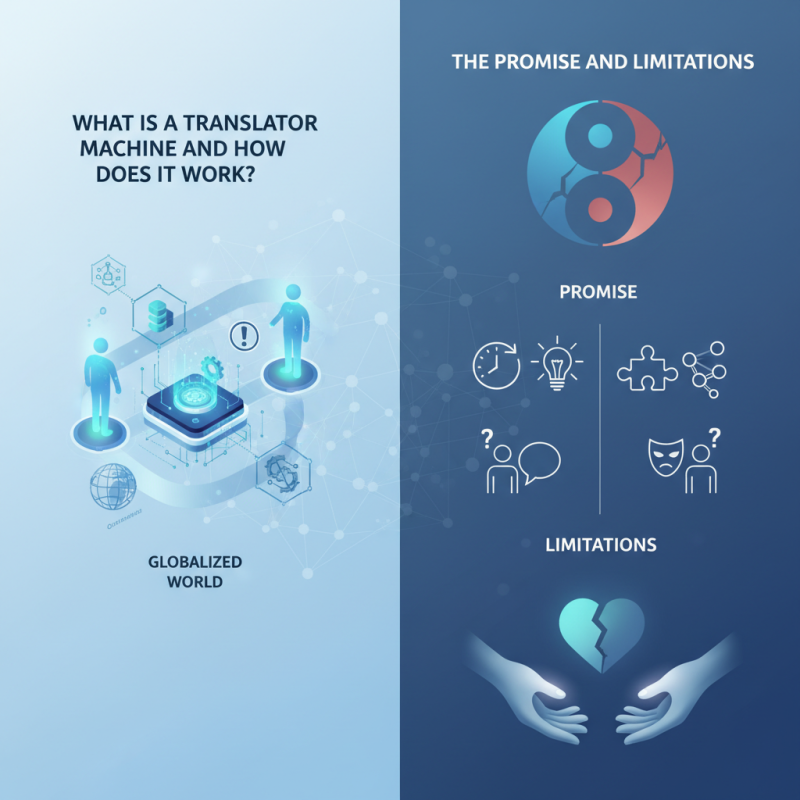
In an increasingly globalized world, the "translator machine" has become essential for communication across languages. Dr. Lisa Merritt, a linguistic expert and former head of the International Translation Institute, once stated, “Translator machines bridge understanding, but they are not flawless.” This highlights both the promise and the limitations of this technology.
A translator machine uses algorithms and vast databases to convert text from one language to another. It analyzes phrases, grammar, and context to generate translations. However, many nuances can be lost. Jargon, idioms, and cultural references may not always translate accurately. Thus, while these tools provide rapid translations, they should not replace human translators entirely.
Understanding the functions and flaws of translator machines is crucial. Users must recognize when to rely on them and when to consult a professional. The rise of this technology invites reflection on the balance between efficiency and authenticity in translation. The journey of language translation is not just about words; it is about conveying meaning across cultures.
What is a Translator Machine?
A translator machine is a device designed to convert text or speech from one language to another. These machines use complex algorithms and language databases to perform translations. They have evolved significantly over the years, thanks to advances in artificial intelligence, specifically neural networks. According to a report by Statista, the machine translation market is projected to reach 1.9 billion U.S. dollars by 2024, highlighting its growing relevance in our globalized world.
The accuracy of translator machines can vary. In contexts with nuanced language, such as poetry or idiomatic expressions, these machines may struggle to convey the original meaning. For instance, a study by the European Commission revealed that 55% of users found machine translations insufficiently accurate for business communications. This raises questions about reliability and the limits of technology. While translator machines save time, their imperfections remind us of the value of human translators. Understanding complex cultural references often remains beyond the scope of current technology.
Furthermore, the integration of these machines in various industries reflects their practical applications. From customer support to content localization, organizations increasingly rely on these tools. Nevertheless, their limitations can't be ignored. Some languages, especially those with less online presence, receive far less support, leading to further disparities in translation quality.
What is a Translator Machine and How Does It Work?
| Feature |
Description |
Example Usage |
| Input Language |
The language of the text to be translated. |
Spanish |
| Output Language |
The language into which the text is translated. |
English |
| Translation Method |
The approach used for translation, e.g., Statistical Machine Translation or Neural Machine Translation. |
Neural Machine Translation |
| Accuracy |
The level of correctness in translating text, often measured in BLEU scores. |
85% BLEU Score |
| User Input |
The type of user engagement allowed, e.g., text input, speech input. |
Text Input |
| Output Format |
The format of the translated output, whether plain text, HTML, etc. |
Plain Text |
| Real-time Translation |
Ability to translate text instantly or with minimal delay. |
Yes |
| API Integration |
The possibility to integrate with other applications or services. |
Available |
Historical Development of Translator Machines
The history of translator machines dates back to the early days of computing. In the 1950s, researchers experimented with simple rule-based systems. These machines relied heavily on grammatical rules and vocabulary lists. Early successes showed promise but faced many limitations. Translations were often rigid and lacked context.
As technology progressed, the field evolved. By the 1980s, statistical approaches emerged, offering more flexibility. They analyzed large corpora of bilingual texts. This method generated translations based on probability rather than strict rules. However, it led to awkward phrases, reminding us that machines still struggled with nuance.
Today, artificial intelligence drives translator machines. Neural networks and deep learning have transformed the accuracy of translations. While significant advancements have been made, challenges remain. Contextual understanding is an ongoing concern. Machines often miss subtle meanings and cultural references. This highlights the need for human oversight in translation processes.
Core Technologies Behind Translation Machines
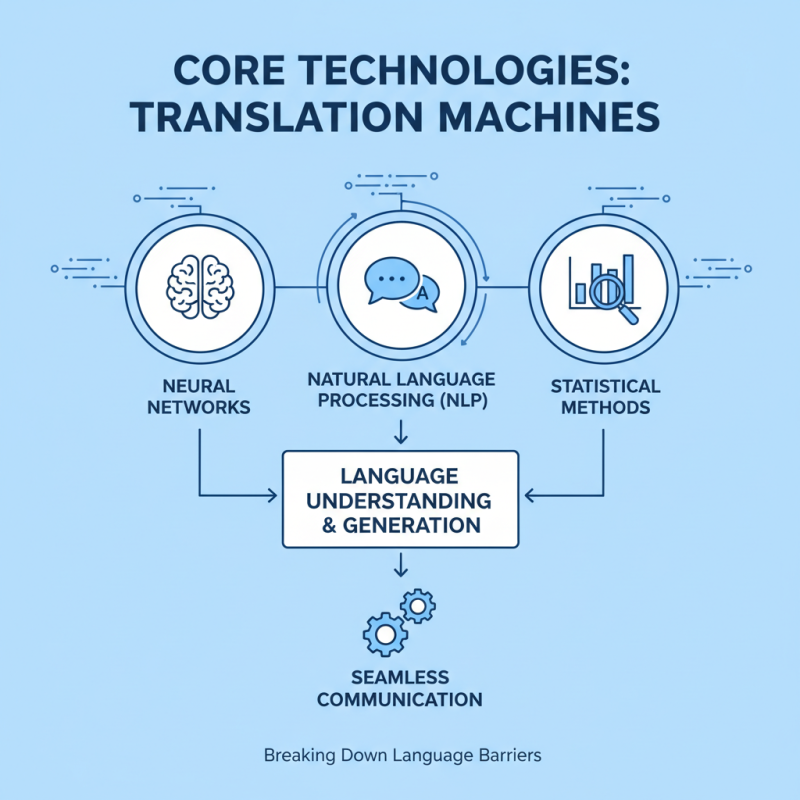
Translation machines leverage advanced technologies to provide seamless communication across languages. At the core of these machines are algorithms that utilize natural language processing (NLP), statistical methods, and neural networks. NLP helps machines understand and generate human language effectively. This involves breaking down sentences into their underlying structures, making it easier to analyze context.
Neural networks play a crucial role in improving translation accuracy. These networks learn from vast amounts of data, allowing the machine to grasp nuances and idiomatic expressions in various languages. However, the technology still struggles with context in complex sentences. Challenges remain, especially with languages that have different syntax structures or cultural contexts.
Tip: Always review machine translations. They may miss the nuances of your message. Use them as a tool, but don’t rely solely on them. Also, consider the language pair; some languages translate better than others.
Understanding the limitations of translation technology is vital. Not all phrases translate perfectly. For instance, idiomatic expressions may fail to convey their intended meaning. Continuous refinement and human oversight are essential to enhance the reliability of these translation machines.
How Translator Machines Process Language
Translator machines utilize complex algorithms to analyze and convert language. These systems often employ neural networks to understand context and nuance. According to a report by Statista, the global machine translation market was valued at about $700 million in 2021 and is expected to grow significantly in the coming years. This highlights the increasing reliance on technology for language processing.
Language processing begins with tokenization, breaking down text into smaller elements. These tokens are then analyzed to establish relationships between words. Recent advancements, such as transformer models, have improved the accuracy of translations. However, contextual subtleties can sometimes be lost in translation. For example, idiomatic expressions may not translate directly, leading to potential misunderstandings.
Tip: Always provide context when using automated translations. This can enhance the quality and accuracy of the output. Be aware that no machine can fully replace human insight. As you explore translator machines, scrutinize their capabilities closely. Regularly reflecting on their limitations can foster a more nuanced understanding of what these tools can achieve.
Translator Machine Performance Metrics
This bar chart illustrates the performance metrics of translator machines across various dimensions including translation accuracy, speed of translation, language variety, user satisfaction, and cost efficiency.
Applications and Limitations of Translator Machines
Translator machines have transformed how we communicate across languages. They are widely used in various fields, including travel, business, and education. In many ways, these machines enhance accessibility to information and foster global interactions.
For instance, they can translate text in real time, allowing users to converse seamlessly. Applications like these showcase the potential of technology to bridge language barriers.
However, translator machines have notable limitations. They often struggle with idiomatic expressions and cultural nuances. Some translations may feel robotic or lack the fluidity of a native speaker. Context can be lost, leading to misunderstandings.
These machines also rely heavily on training data, which can perpetuate biases. As a result, relying solely on translator machines could lead to less accurate communication. Users must reflect on these shortcomings and remain vigilant when interpreting translations.
.svg)


.svg)

.svg)


 052925 - AI Translation 101 (1).png)


.svg)

.svg)


.jpg)